If you’ve ever looked up on a warm August night and watched a bright streak of light race across the sky, you’ve probably witnessed the Perseid meteor shower—one of the most spectacular annual astronomical events visible from Earth.
Every year, millions of people across North America stay awake late or wake up before sunrise hoping to catch a glimpse of what many casually call “shooting stars.” Social media fills with breathtaking photographs, astronomy enthusiasts gather in parks and open fields, and families spread blankets across their backyards for one of nature’s most beautiful free shows.
The excitement surrounding the Perseids returns every summer because they’re among the most reliable and active meteor showers of the year. In 2026, astronomers once again expect the display to peak in August, with favorable viewing conditions thanks to a relatively dark sky around the peak period. NASA and the American Meteor Society publish annual viewing guidance to help skywatchers find the best time and location to observe the event.
But despite its popularity, many people don’t actually know what they’re looking at.
Those bright streaks aren’t stars falling from the sky.
They’re not pieces of planets.
And surprisingly, they aren’t even unique to Earth.
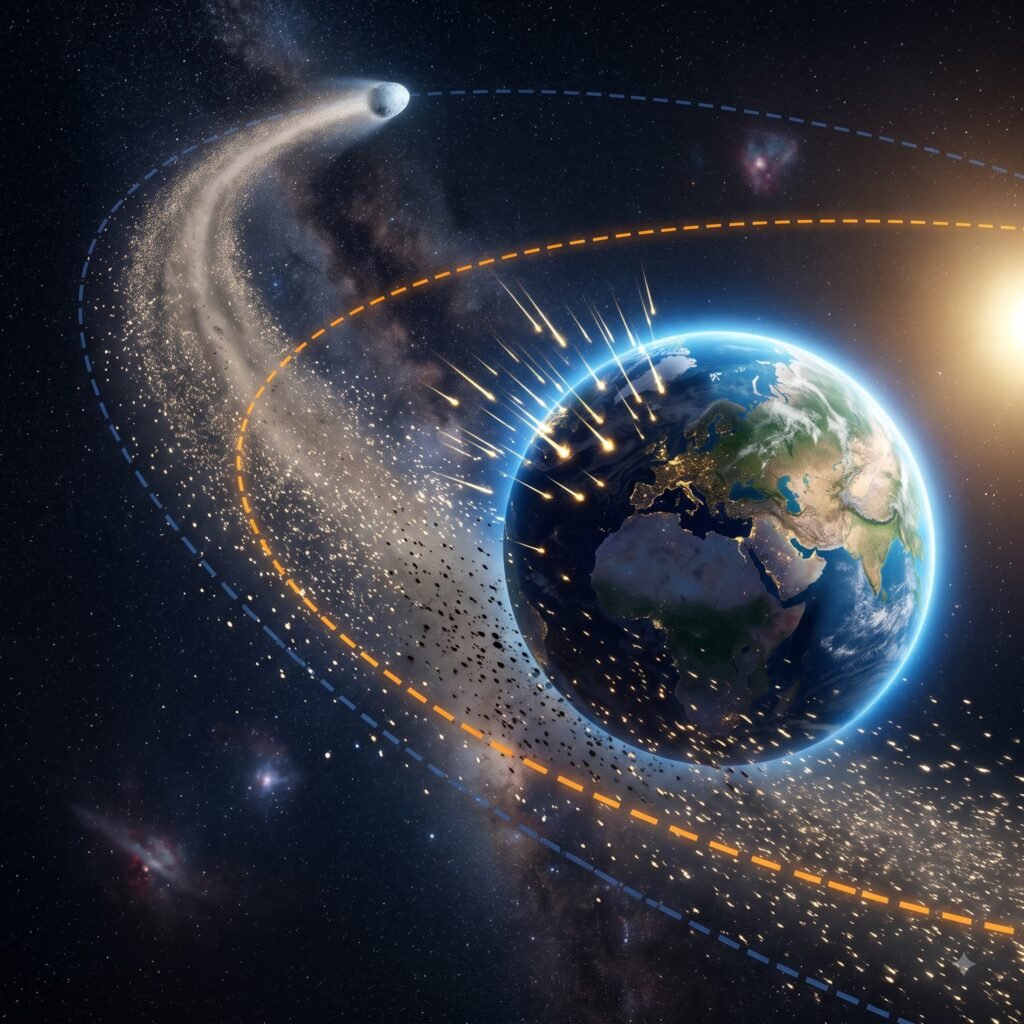
The Perseid meteor shower is the result of our planet traveling through an ancient trail of cosmic debris left behind by a giant comet thousands of years ago. Every August, Earth passes through this invisible stream of dust and rock, creating one of the most predictable and breathtaking celestial displays visible to the naked eye.
The science behind it is just as fascinating as the view itself.
Here are five amazing facts about the Perseid meteor shower that most people don’t know.
1. They’re Not Actually “Shooting Stars”
One of the biggest misconceptions about the Perseid meteor shower starts with its nickname.
For centuries, people have called these bright streaks shooting stars.
The name sounds poetic—but it’s scientifically inaccurate.
A star is an enormous ball of hot gas, like our own Sun, located trillions of miles away. Stars don’t suddenly fall into Earth’s atmosphere.
What you’re actually seeing is something much smaller.
Most Perseid meteors begin as tiny pieces of rock and dust, many no larger than a grain of sand or a small pebble. These particles are called meteoroids while they’re still traveling through space.
As Earth moves through the debris field, these tiny fragments slam into our atmosphere at incredible speeds—around 37 miles (59 kilometers) per second.
At that speed, they don’t simply fall.
They collide with Earth’s atmosphere with tremendous energy.
The friction and compression heat the surrounding air to thousands of degrees, causing the particle to glow brilliantly for just a fraction of a second.
That glowing streak is called a meteor.
In other words:
- Meteoroid = the object in space
- Meteor = the glowing streak you see in the sky
- Meteorite = any piece that survives the journey and reaches the ground
Most Perseid meteors never become meteorites because they’re incredibly small. They burn up completely high above Earth’s surface, often at altitudes between 50 and 75 miles (80–120 kilometers).
That’s why they’re perfectly safe to watch.
The spectacular flash of light is simply the final moment of a tiny piece of cosmic debris that has been traveling through space for centuries before meeting Earth’s atmosphere.
Also Read: 7 Alarming Ways Water System Cyberattacks Could Affect Everyday Americans
2. The Perseid Meteor Shower Comes From a Giant Comet Older Than Human Civilization
Every meteor shower has a source.
For the Perseid meteor shower, that source is Comet Swift–Tuttle.
Discovered independently in 1862 by astronomers Lewis Swift and Horace Parnell Tuttle, this massive comet travels around the Sun in an enormous orbit that takes approximately 133 years to complete.
Unlike planets, comets are often described as “dirty snowballs.”
They’re made of:
- Ice
- Frozen gases
- Dust
- Rocky material
- Organic compounds
As Comet Swift–Tuttle approaches the Sun, its icy surface begins to warm.
Some of the ice changes directly into gas, carrying tiny dust particles and small rocks away from the comet.
This creates the comet’s famous glowing tail—but it also leaves something far less obvious behind.
Imagine walking through a forest while dropping breadcrumbs along the trail.
Long after you’ve left, the trail remains.
Comet Swift–Tuttle does something similar.
Every time it circles the Sun, it leaves behind an enormous stream of tiny particles stretching millions of miles through space.
Earth crosses this trail every August.
When our planet enters this invisible river of debris, countless particles begin entering the atmosphere, producing the bright flashes we call Perseid meteors.
What’s remarkable is that many of the particles you see burning up tonight may have separated from the comet hundreds—or even thousands—of years ago.
Some of the light streaking across the sky could be debris released before many modern nations even existed.
In a way, watching the Perseid meteor shower is like watching pieces of ancient solar system history disappear in brilliant flashes above your head.
3. Why the Perseids Return at Almost Exactly the Same Time Every Year
One of the most fascinating things about the Perseid meteor shower is how predictable it is.
Unlike many natural events, astronomers don’t have to guess when it will happen.
They know.
That’s because the Earth follows nearly the same path around the Sun every year.
As our planet completes one orbit approximately every 365 days, it reaches the same region of space where Comet Swift–Tuttle left its debris.
Think of Earth’s orbit as a giant racetrack.
Every August, Earth reaches the same stretch of the track—and every August, that stretch happens to be filled with millions of tiny comet particles.
The result is the annual Perseid meteor shower.
Although the shower is active for several weeks, there is always a peak period, when Earth passes through the densest part of the debris stream.
During those peak nights, observers under dark skies may see dozens of meteors every hour, with occasional bright fireballs making the display even more memorable.
Of course, not every year offers identical viewing conditions.
Several factors influence how many meteors people actually see:
- Moonlight can wash out fainter meteors.
- Cloud cover may block the sky completely.
- Light pollution from cities makes faint meteors harder to spot.
- Your location and local weather also play a role.
That’s why experienced skywatchers often recommend traveling away from city lights whenever possible.
A dark rural location can reveal dramatically more meteors than a brightly lit urban neighborhood.
Even though the Perseid meteor shower follows an incredibly reliable schedule, every viewing experience is slightly different—which is part of what makes the event so special.
4. Some Perseid Meteors Are Bright Enough to Outshine Venus
If you’ve watched the Perseid meteor shower before, you may have noticed that not all meteors look the same.
Some appear as quick, faint streaks that disappear almost instantly.
Others suddenly blaze across the sky, leaving glowing trails behind them and briefly illuminating the landscape.
These exceptionally bright meteors are known as fireballs.
Fireballs occur when larger pieces of comet debris enter Earth’s atmosphere. Because they contain more material, they release significantly more energy as they burn, making them much brighter than the average meteor.
Some fireballs become brighter than Venus—the brightest planet visible in the night sky—and can even cast faint shadows under very dark conditions.
One of the reasons the Perseid meteor shower is famous is because it produces an unusually high number of these brilliant fireballs.
Scientists believe this happens because Comet Swift-Tuttle left behind debris of many different sizes. While most particles are no bigger than grains of sand, others are considerably larger.
As these larger fragments strike Earth’s atmosphere at approximately 37 miles (59 kilometers) per second, the tremendous energy released creates spectacular flashes that can remain visible for several seconds.
Some fireballs even leave behind glowing vapor trails called persistent trains.
These trails aren’t smoke.
Instead, they’re glowing gases in the upper atmosphere that have been ionized by the intense heat of the meteor.
Depending on atmospheric conditions, these luminous trails can remain visible for several minutes while twisting and changing shape in high-altitude winds.
This is why experienced meteor watchers often become even more excited after spotting a particularly bright meteor.
Sometimes the meteor is only the beginning of the show.
5. You Don’t Need a Telescope to Enjoy the Perseid Meteor Shower
One of the best things about the Perseid meteor shower is that it’s completely different from most astronomical events.
Want to observe Saturn?
You’ll probably need a telescope.
Want to see distant galaxies?
Again, a telescope—or at least binoculars—will help.
But meteor showers work differently.
In fact, a telescope can actually make watching the Perseids more difficult.
That’s because telescopes dramatically reduce your field of view.
Instead of seeing the entire sky, you’re only looking at a tiny section of it.
Meteor showers are unpredictable.
A meteor can appear anywhere.
The wider your view, the greater your chances of spotting one.
For that reason, astronomers recommend using nothing more than your own eyes.
Simply find a comfortable place to lie down or recline, allow your eyes to adjust to the darkness for about 20 to 30 minutes, and enjoy the sky.
For the best experience:
- Choose a location far from city lights.
- Find an area with an open view of the sky.
- Turn off phone screens whenever possible.
- Give your eyes time to adapt to the darkness.
- Dress appropriately if temperatures become cooler late at night.
Another common misconception is that you need to look toward the constellation Perseus.
While the meteors appear to originate from that area of the sky, they can actually streak across almost any part of the sky.
Many experienced observers recommend looking roughly halfway between the horizon and directly overhead instead of staring at one specific point.
Patience also matters.
Meteor showers aren’t fireworks.
You may wait several minutes between meteors, then suddenly see three or four within a short period.
That’s part of the excitement.
Every observation is unique.
Why the Perseid Meteor Shower Is One of the World’s Favorite Sky Events
There are dozens of meteor showers throughout the year.
So why does the Perseid meteor shower receive so much attention?
Several reasons make it especially appealing.
It Happens During Summer
Across much of the Northern Hemisphere, August brings relatively warm nights.
People can comfortably spend time outdoors without heavy winter clothing.
Families often combine meteor watching with camping trips, beach visits or evenings in the backyard.
It Produces Large Numbers of Meteors
During peak activity under dark skies, observers can sometimes see 50 to 100 meteors per hour, although the exact number depends on weather, moonlight and observing conditions.
Few annual meteor showers consistently produce displays this active.
It Has a Long History
Historical records suggest people have been observing the Perseids for nearly 2,000 years.
In Europe, the shower even earned the nickname “The Tears of Saint Lawrence,” because its annual appearance often coincides with the feast day of Saint Lawrence in early August.
Long before modern astronomy explained meteor showers, cultures around the world created legends and stories to explain these mysterious lights in the sky.
Today we understand the science—but the sense of wonder remains exactly the same.
It’s Accessible to Almost Everyone
Unlike solar eclipses or rare planetary alignments, you don’t need expensive equipment or travel across continents.
If the skies are clear and you’re away from heavy light pollution, you already have everything you need.
That accessibility has helped make the Perseid meteor shower one of the most anticipated astronomical events of every summer.
How Scientists Study Meteor Showers
Although meteor showers are beautiful to watch, they’re also scientifically valuable.
Every meteor represents a tiny piece of material left over from the formation of our solar system more than 4.5 billion years ago.
Studying these particles helps scientists better understand:
- The composition of comets
- The evolution of the solar system
- How planets formed
- The movement of small objects through space
- Earth’s interaction with interplanetary debris
Organizations such as NASA and the American Meteor Society use a combination of technology to monitor meteor activity.
This includes:
Radar Systems
Radar detects meteors even during daylight or cloudy conditions by tracking the ionized trails they leave behind in the upper atmosphere.
All-Sky Cameras
Special cameras continuously photograph the night sky, allowing researchers to calculate meteor speed, direction and brightness.
Satellite Observations
Spacecraft also contribute valuable information by observing Earth’s atmosphere and detecting larger meteors entering from space.
Citizen Scientists
Interestingly, ordinary people also play an important role.
Organizations such as the American Meteor Society encourage observers to report what they see.
Thousands of public observations each year help researchers verify meteor activity, identify especially bright fireballs and improve future predictions.
In other words, someone watching the Perseid meteor shower from their backyard can actually contribute useful scientific information.
Can Light Pollution Affect What You See?
Absolutely.
Light pollution is one of the biggest reasons people in large cities miss many meteors.
Artificial lighting brightens the night sky and reduces contrast, making faint meteors almost invisible.
This doesn’t mean city residents can’t enjoy the Perseids.
Bright meteors and fireballs can still be visible from urban areas.
However, someone watching from a remote national park or rural countryside may see several times more meteors during the same period.
This difference has inspired many astronomy enthusiasts to travel specifically for meteor showers.
National parks, state parks and certified dark-sky locations often become popular destinations during peak Perseid activity.
For many observers, the journey itself becomes part of the experience.
Standing beneath a truly dark sky, with the Milky Way stretching overhead and meteors appearing every few minutes, reminds us just how much of the universe is hidden by everyday city lights.
Why the Perseids Continue to Inspire Wonder
Modern astronomy has answered many of the questions people once asked about meteor showers.
We know where the Perseids come from.
We know why they return every August.
We know why they glow.
We can even predict when they’ll reach their peak.
Yet despite all that scientific knowledge, watching a brilliant meteor streak silently across the night sky still feels magical.
Perhaps that’s because the Perseid meteor shower reminds us of something easy to forget.
Our planet isn’t isolated.
Every day, Earth moves through an enormous cosmic environment filled with ancient dust, rocky fragments and remnants of objects that have traveled through the solar system for millions—even billions—of years.
For just a few nights each August, we get to see that invisible journey made visible.
And all we have to do is look up.
Frequently Asked Questions
What is the Perseid meteor shower?
The Perseid meteor shower is an annual meteor shower that occurs when Earth passes through a stream of dust and rocky debris left behind by Comet Swift–Tuttle. As these tiny particles enter Earth’s atmosphere at high speed, they burn up and create the bright streaks of light commonly called “shooting stars.”
When does the Perseid meteor shower happen?
The Perseid meteor shower is active every year from mid-July through late August, with peak activity usually occurring around August 11–13. The exact peak can vary slightly from year to year.
Do I need a telescope to see the Perseids?
No. The Perseid meteor shower is best viewed with the naked eye. Telescopes and binoculars limit your field of view, making it harder to spot meteors that can appear anywhere in the sky.
Why are they called the Perseids?
The meteors appear to radiate from the direction of the constellation Perseus. This point is called the radiant, which is why the shower is known as the Perseid meteor shower.
Are shooting stars actually stars?
No. Shooting stars are not stars at all. They are tiny pieces of comet debris burning up in Earth’s atmosphere as they travel at extremely high speeds.
Is the Perseid meteor shower dangerous?
No. The meteors burn up high in Earth’s atmosphere, typically between 50 and 75 miles (80–120 km) above the surface. They pose no danger to people watching from the ground.
Final Thoughts
Every August, millions of people pause for a moment, step outside, and look toward the night sky hoping to catch a glimpse of a shooting star.
But as we’ve learned, the Perseid meteor shower is far more than a beautiful celestial display.
It is the result of Earth’s annual journey through a stream of ancient comet debris—a reminder that our planet is constantly moving through a dynamic solar system filled with objects that have existed for millions of years.
Understanding the science behind the Perseids doesn’t diminish their beauty. If anything, it makes the experience even more remarkable.
The next time you see a bright streak flash across the sky, you’ll know you’re witnessing a tiny fragment of Comet Swift–Tuttle completing an extraordinary journey that may have begun centuries—or even thousands of years—ago.
Whether you’re watching from a quiet countryside, a national park, or your own backyard, the Perseids remain one of the few natural wonders that anyone can enjoy without a ticket, special equipment, or scientific training.
Sometimes, all it takes is a clear night and the curiosity to look up.
External Sources: ABC7 New York