What Is Small-Ball Basketball? 5 Ways It Changed the NBA
The NBA looks very different today than it did a few decades ago. Teams spread players across the floor, centers are expected to shoot, big men handle the ball, and three-point shooting has become central to many offenses.
One of the ideas behind that transformation is small-ball basketball.
The basic concept sounds simple: instead of relying on a traditional lineup with a large center and power forward, a team uses smaller, faster and more versatile players. But small-ball is about much more than putting shorter players on the court. It changes how a team attacks, defends and creates mismatches.
The approach was famously associated with Hall of Fame coach Don Nelson, whose unconventional ideas helped push the NBA toward faster, more flexible basketball. Nelson pioneered the “point forward” concept in Milwaukee and later developed what became known as “Nellie Ball” during his coaching career.
Today, many of those ideas are no longer considered unusual.
They’re part of modern basketball.
So what exactly is small-ball basketball, and how did it help change the NBA?
What Is Small-Ball Basketball?
Small-ball basketball is a strategy in which a team deliberately uses a lineup that is smaller—or at least less traditional—than a conventional lineup.
A traditional lineup might feature:
- A point guard
- A shooting guard
- A small forward
- A power forward
- A center
In a small-ball lineup, a team might replace a traditional big man with a smaller, quicker player who can shoot, pass, defend multiple positions or handle the ball.
The objective isn’t simply to become “small.”
The objective is to create speed, spacing and mismatches.
Imagine a traditional center trying to defend a smaller player who can shoot three-pointers and attack off the dribble. The center may be forced away from the basket, opening space for other players.
On the other end of the court, the smaller lineup can move the ball quickly and force slower defenders to constantly react.
That’s the basic appeal of small-ball.
But the idea didn’t suddenly appear in today’s NBA.
One of its most influential architects was Don Nelson.
Don Nelson and the Rise of “Nellie Ball”
Don Nelson spent 31 seasons as an NBA head coach with Milwaukee, Golden State, New York and Dallas. He finished his coaching career with 1,335 regular-season victories, a total that ranks second in NBA history.
His willingness to challenge conventional basketball thinking became one of the defining characteristics of his career.
While coaching the Milwaukee Bucks, Nelson pioneered the point forward concept by allowing forward Paul Pressey to handle the ball and create plays—something that challenged the traditional idea that guards should be the primary creators.
Later, during his time with Golden State, Nelson developed an up-tempo approach built around players such as Tim Hardaway, Mitch Richmond and Chris Mullin.
That group became known as Run TMC.
The Warriors’ approach emphasized speed, passing and attacking before the defense could get organized. NBA.com describes Nelson’s Golden State system as an early form of small-ball that emerged partly because the team lacked a traditional dominant big man.
The important part wasn’t simply that Nelson used smaller players.
It was that he recognized something many coaches were still reluctant to embrace:
A smaller player can create a bigger problem for the opposing team if that player has the right skills.
And that idea would eventually spread far beyond Nelson’s teams.
Also read: 7 Surprising Reasons E-Bike Crashes Are Rising in American Cities
1. Speed Became More Important Than Size
Traditional basketball often placed a premium on having a dominant big man near the basket. A large center could score in the post, protect the rim and control rebounds.
Small-ball challenged that formula.
Instead of asking, “How big is our lineup?”, coaches began asking:
“How many things can our players do?”
A smaller lineup can move the ball faster, run the floor more effectively and force larger opponents into uncomfortable defensive situations.
Imagine a 7-foot center guarding a 6-foot-5 forward who can shoot from the perimeter, put the ball on the floor and drive to the basket.
If the center stays near the paint, the smaller player can shoot.
If the center moves outside to defend the shooter, the smaller player can attack the space behind him.
That creates what basketball coaches call a mismatch.
Don Nelson’s Warriors demonstrated an early version of this philosophy. His Run TMC lineup—Tim Hardaway, Mitch Richmond and Chris Mullin—was built around speed and scoring rather than a traditional dominant big man. NBA.com describes Nelson’s system as an early form of small-ball that was partly born from the Warriors’ lack of a functional big man.
The approach was entertaining, but it also revealed an important tactical advantage:
Sometimes being smaller can actually make a team harder to defend.
2. Three-Point Shooting Became a Major Weapon
Small-ball became even more powerful as teams increasingly recognized the value of the three-point shot.
A team doesn’t necessarily need a traditional center standing close to the basket if its players can consistently threaten the defense from outside.
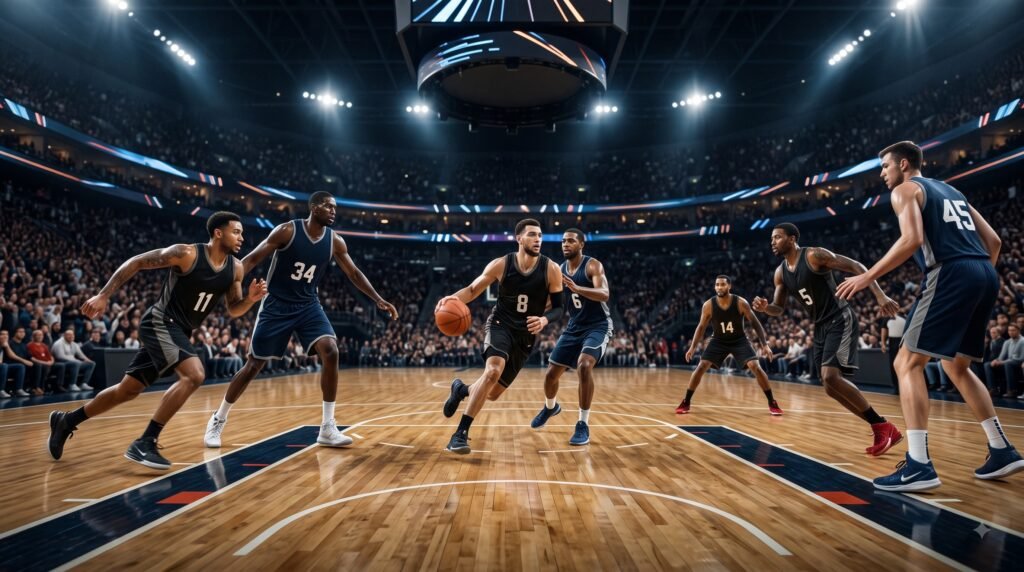
Instead, imagine five offensive players spread around the court.
The defense has a problem.
If defenders stay close to the basket, the shooters have open looks.
If defenders spread out to cover those shooters, driving lanes appear.
That spacing is one of the central ideas behind modern small-ball basketball.
The result is a game in which players who might once have been considered “too small” for certain positions can become extremely valuable if they can shoot, pass and create opportunities.
This also changed what teams looked for when evaluating players.
Size still matters—but skill became increasingly difficult to ignore.
3. Centers Had to Change Their Game
Perhaps no position illustrates the transformation better than the center.
For decades, the traditional center was expected to operate primarily around the basket.
Rebound.
Block shots.
Set screens.
Score in the post.
Modern basketball increasingly asks centers to do much more.
A center who can shoot from outside forces defenders to leave the paint. A center who can pass makes it harder for defenses to predict where an offense will attack. A center who can defend multiple positions can switch onto smaller players without immediately creating a mismatch.
This doesn’t mean traditional centers disappeared.
Instead, the definition of a valuable big man expanded.
The Golden State Warriors provided one of the clearest examples through Draymond Green, whose versatility allowed the team to use smaller lineups while still maintaining defensive strength and playmaking. NBA.com notes that Green’s skill and instincts helped him become one of the league’s most versatile players despite being considered undersized for a traditional frontcourt role.
That is one of the most important ideas behind small-ball:
A player’s position becomes less important when his skills allow him to perform multiple roles.
4. Positionless Basketball Became the New Normal
Once teams realized that players didn’t have to stay within traditional roles, another idea began to emerge:
positionless basketball.
Instead of having one player who only handles the ball, another who only shoots and another who only plays near the basket, teams can use players with overlapping abilities.
A forward can bring the ball up.
A center can pass.
A guard can defend a bigger player.
A big man can shoot a three.
The result is a much more fluid style of basketball.
Don Nelson’s influence can be seen here as well. His point-forward concept with Milwaukee challenged the traditional division between guards and forwards by giving forward Paul Pressey significant ball-handling and playmaking responsibilities. NBA.com identifies Nelson as a pioneer of the point-forward concept.
The idea has evolved considerably since then, but the basic principle remains:
Don’t let a player’s listed position limit what he can do.
5. It Changed How Teams Build Their Rosters
Small-ball didn’t just change what happened during games.
It changed what teams looked for before the games even began.
Scouts and executives increasingly had reasons to value players who could perform several jobs.
A modern prospect might be particularly valuable because he can:
- Shoot from the perimeter
- Defend multiple positions
- Handle the ball
- Pass
- Switch defensively
- Run in transition
- Create space for teammates
This versatility can make a player useful in several different lineups rather than only one traditional role.
It also gives coaches more options.
A team can start with a traditional lineup and then go smaller when it needs more speed or spacing.
Or it can use a larger lineup when it needs rebounding and interior defense.
Small-ball therefore became less of a fixed lineup and more of a strategic weapon.
And that is a major reason its influence has lasted.
How Don Nelson Influenced Today’s NBA
Don Nelson’s influence on basketball wasn’t limited to one particular lineup or one team. His bigger contribution was his willingness to challenge assumptions about how basketball was supposed to be played.
He experimented with players in unconventional roles, pushed the pace of games and looked for ways to create mismatches instead of simply matching his lineup against the opponent’s.
One of his most important innovations was the point forward.
Rather than requiring a traditional point guard to control every possession, Nelson gave forward Paul Pressey major ball-handling and playmaking responsibilities while coaching the Milwaukee Bucks. The concept demonstrated that a player didn’t have to be a traditional guard to organize an offense.
That idea may sound normal today.
It wasn’t always.
Modern NBA offenses regularly feature forwards and centers bringing the ball up the court, initiating plays and creating shots for teammates. Nelson’s experiments helped demonstrate how valuable that flexibility could be.
Nellie Ball
Nelson’s later work with the Golden State Warriors became closely associated with “Nellie Ball.”
The approach emphasized:
- Speed
- Spacing
- Three-point shooting
- Versatility
- Constant movement
- Creating defensive mismatches
His Warriors teams were not necessarily built around overpowering opponents with size.
Instead, they attempted to make size itself a disadvantage for the opposing team.
A slower big man might struggle to keep up with smaller players running around the perimeter. A traditional defender could be forced away from the basket. And once the defense was stretched, quick players could attack open spaces.
That basic concept would become increasingly important as the NBA evolved.
Which Teams Helped Perfect Small-Ball Basketball?
Don Nelson helped establish the philosophy, but other teams eventually demonstrated just how effective small-ball could become.
Golden State Warriors
The Warriors became one of the clearest examples of modern small-ball during their championship era.
With Stephen Curry and Klay Thompson providing elite perimeter shooting and Draymond Green supplying defense, passing and playmaking, Golden State could create lineups that were difficult to defend and equally difficult to attack.
The team’s “Death Lineup” became particularly famous.
Rather than relying on a traditional center, Golden State could use Green as its nominal center while surrounding him with elite shooters.
That lineup forced opponents into difficult choices.
Guard the shooters closely and risk giving up driving lanes.
Protect the paint and risk giving up open three-pointers.
Try to match Golden State’s speed and risk being outmuscled by its skill.
The Warriors didn’t invent every element of small-ball, but they demonstrated what the strategy could look like when combined with elite shooting and defense.
Miami Heat
The Miami Heat also showed how a smaller lineup could work without sacrificing competitiveness.
During the team’s successful 2010s period, players such as LeBron James and Chris Bosh gave Miami unusual flexibility.
James could handle the ball like a guard while defending multiple positions.
Bosh, meanwhile, could play away from the basket and stretch the floor more than many traditional centers of his era.
That combination allowed Miami to change its style depending on the matchup.
Small-ball wasn’t necessarily about staying small for an entire game.
It was about having the ability to change the shape of the game when necessary.
Houston Rockets
The Houston Rockets pushed the philosophy in another direction.
During the late 2010s, Houston became known for extreme spacing, heavy three-point shooting and lineups that often minimized traditional center play.
The team demonstrated just how far the small-ball concept could be taken.
But it also exposed one of the strategy’s weaknesses.
A smaller team can create offensive advantages, but it can also give up size and rebounding.
That trade-off is at the heart of the small-ball debate.
Is Small-Ball Still Dominating the NBA?
Not exactly.
And that’s an important part of the story.
Small-ball didn’t replace traditional basketball.
Instead, it expanded the number of ways a team can play.
Modern NBA teams can switch between different styles depending on their opponent.
A coach might use a smaller lineup when:
- The team needs more shooting
- The opponent has slow defenders
- The game requires a faster pace
- The team needs to create driving lanes
But a larger lineup may be preferable when:
- Rebounding becomes important
- The opponent has a dominant center
- Interior defense is needed
- The team needs more physicality
The modern game is therefore less about choosing between “big” and “small.”
It’s about finding players who can provide size without sacrificing skill, or skill without becoming a defensive liability.
That’s why today’s most valuable players are often those who can do several things well.
Why Small-Ball Changed Basketball Beyond the NBA
The influence of small-ball extends beyond the NBA itself.
Youth basketball programs, college teams and international leagues have increasingly emphasized spacing, shooting and versatile players.
Young players are also encouraged to develop multiple skills rather than becoming locked into a single position at an early age.
A tall player is no longer necessarily expected to spend the entire game near the basket.
A guard may be expected to defend bigger players.
A forward may be expected to initiate an offense.
The result is a game that gives coaches more possibilities than the traditional position-based model.
And that may ultimately be the most important legacy of small-ball.
It changed the question from:
“What position does this player play?”
to:
“What can this player do?”
Final Thoughts
Small-ball basketball wasn’t simply about making lineups shorter.
It was about challenging one of basketball’s oldest assumptions: that bigger is always better.
Coaches like Don Nelson showed that speed, shooting, creativity and versatility could sometimes create bigger advantages than size alone.
Over time, those ideas became increasingly common.
The three-point shot became more important. Centers began shooting from the perimeter. Forwards became playmakers. Guards became capable of defending bigger opponents.
And the boundaries between positions became increasingly blurred.
Today’s NBA isn’t purely a small-ball league. Traditional big men still matter, and size remains one of basketball’s most valuable physical advantages.
But the modern game gives teams another option.
They can play big.
They can play small.
Or, increasingly, they can play versatile.
That may be the most lasting legacy of small-ball basketball: it didn’t eliminate the traditional game—it gave basketball another way to be played.
Frequently Asked Questions
What is small-ball basketball?
Small-ball basketball is a strategy that uses smaller, faster and more versatile lineups to create advantages through speed, spacing, shooting and defensive flexibility rather than relying primarily on size and traditional post play.
Who invented small-ball basketball?
There isn’t one person who invented small-ball basketball. However, Don Nelson is widely credited with being one of its most influential early innovators. His use of unconventional lineups and the point-forward concept helped challenge traditional ideas about player positions and lineup construction.
Why is small-ball basketball effective?
Small-ball can force larger defenders to move away from the basket, creating opportunities for outside shots and drives. It can also increase a team’s pace and give coaches more flexibility when attacking different defensive matchups.
What is the NBA Death Lineup?
The “Death Lineup” was a famous small-ball lineup used by the Golden State Warriors that featured Draymond Green at center alongside Stephen Curry, Klay Thompson and other perimeter players. Its combination of shooting, defense, passing and versatility made it extremely difficult for opponents to match up against.
Is small-ball still used in the NBA?
Yes. Small-ball remains an important strategy, although modern teams generally use it alongside traditional larger lineups. Coaches can change lineup sizes depending on the opponent, game situation and skills available on their roster.
Did small-ball eliminate traditional centers?
No. Traditional centers remain valuable, particularly for rebounding, rim protection and interior scoring. What changed is that teams increasingly value centers who can also shoot, pass, defend in space or switch onto smaller players.
The Lasting Legacy of Small-Ball Basketball
Small-ball is ultimately about more than playing without a traditional center.
It represents a broader change in how basketball teams think about players.
The modern NBA increasingly rewards versatility. A player who can shoot, pass, defend and handle the ball can fit into far more situations than someone limited to one traditional role.
That’s why the influence of Don Nelson and other early innovators can still be seen in today’s game.
They didn’t simply make basketball smaller.
They made the definition of a basketball player bigger.