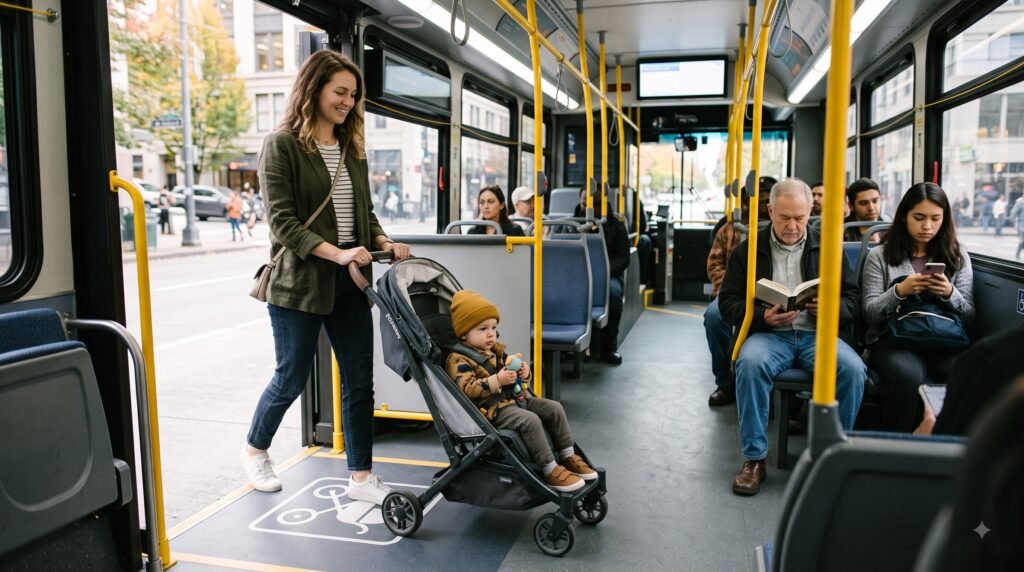
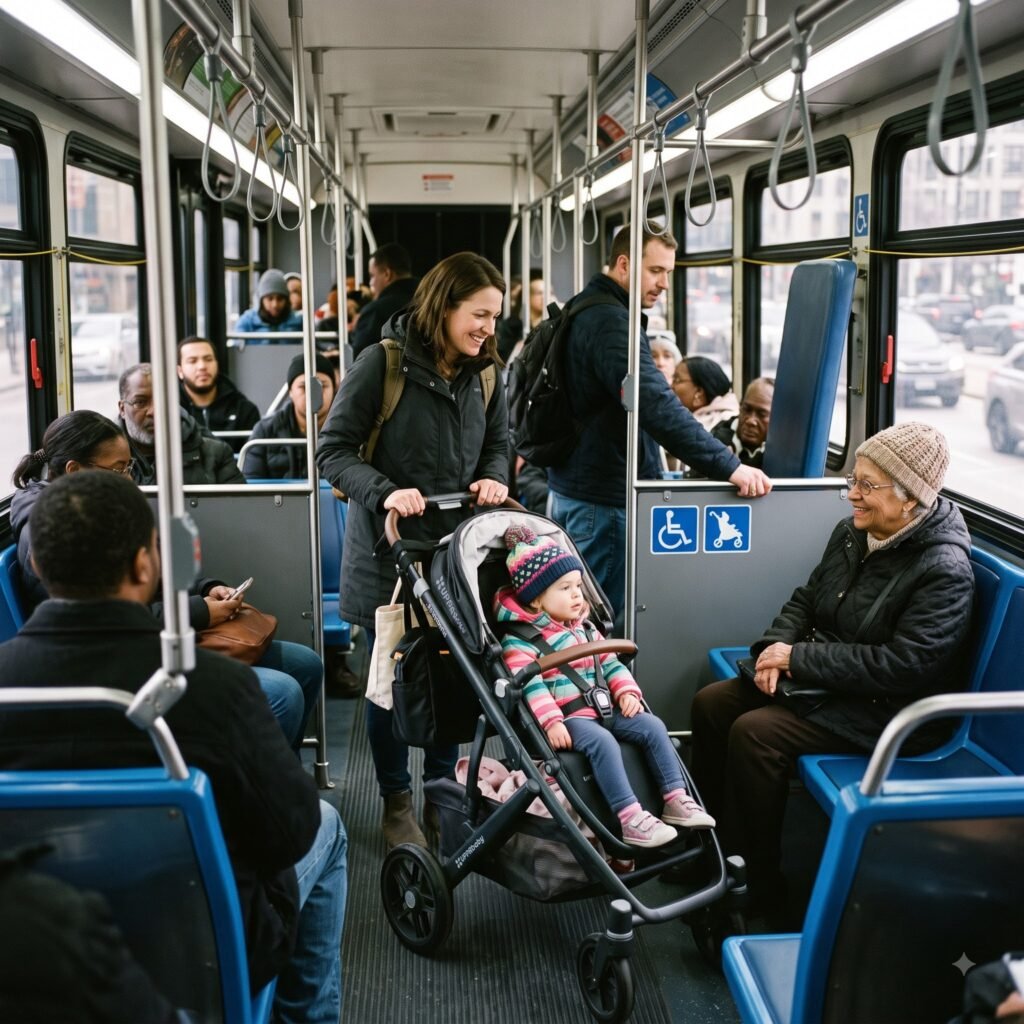
Taking a bus or train alone can be relatively simple. Add a stroller, a toddler, a diaper bag and a tight connection, and the same trip can suddenly become a logistical challenge.
For millions of American families, public transportation with kids is not simply about getting from one place to another. Parents have to think about where the stroller will go, whether there will be enough room to board, how far they will need to walk, whether an elevator will be working and how to keep a child safe in a crowded vehicle.
That’s one reason transit agencies are increasingly looking at how their systems work for families.
In New York City, for example, the Metropolitan Transportation Authority has spent years testing and expanding designated spaces that allow some parents to keep strollers open while riding buses. The program was developed in part because parents and caregivers had difficulty folding strollers while also managing young children.
But the underlying problem isn’t limited to New York.
Across America, public transportation was largely designed around moving passengers efficiently. Families with young children can have very different needs.
Here are seven reasons public transportation with kids can be harder than it looks.
1. A Stroller Can Turn a Simple Trip Into a Space Problem
One of the biggest challenges is surprisingly physical: where does everything go?
A parent traveling with a young child may have a stroller, diaper bag, groceries, toys or other necessities.
On a mostly empty bus, this may not be a major issue.
During rush hour, however, every square foot matters.
A stroller that works perfectly on a sidewalk can become difficult to maneuver through a narrow bus aisle or crowded train platform.
Parents may have to decide whether to:
- Fold the stroller
- Carry the child
- Find a designated stroller area
- Wait for another vehicle
- Ask other passengers to make room
New York’s experience demonstrates how transit agencies are experimenting with dedicated stroller spaces rather than simply expecting parents to solve the problem themselves. The MTA’s pilot eventually expanded to more than 1,000 buses and included designated stroller areas.
That may sound like a small design change, but for a parent carrying a child, it can make an enormous difference.
2. Boarding Is Much Harder With a Young Child
Getting onto a bus or train is something most adults barely think about.
Parents often can’t afford to be that casual.
They may need to:
- Get the child ready to board.
- Move the stroller toward the entrance.
- Keep the child away from traffic.
- Pay or tap a fare.
- Find space inside.
- Secure the stroller.
- Make sure the child remains safe.
All of this may need to happen while other passengers are waiting behind them.
That pressure can make boarding stressful, particularly when the vehicle is crowded or the stop is short.
The issue becomes even more complicated for parents who are traveling alone with more than one child.
Also read: Why E-Bike Crashes Are Rising in American Cities
3. Crowded Vehicles Leave Very Little Room for Error
Public transportation works because many people share the same vehicle.
That’s also what can make it difficult for families.
A crowded bus or train creates challenges that don’t exist when traveling alone.
A child can move unexpectedly. A stroller can block part of an aisle. A parent may have to stand while holding a child and managing bags.
There can also be tension between different passengers who need the same limited space.
This is particularly important because transit systems also have to accommodate passengers with disabilities and mobility devices.
The MTA specifically describes its stroller program as an effort to accommodate families while protecting priority space for customers with disabilities.
In other words, the challenge isn’t simply “finding room for strollers.”
It’s designing a system where different passengers with different needs can share limited space safely.
4. Elevators and Accessibility Can Make or Break the Journey
For a parent with a stroller, stairs aren’t just inconvenient.
They can completely change the journey.
Imagine arriving at a subway station and discovering that the elevator is unavailable.
A person traveling alone might simply take the stairs.
A parent with a stroller and a sleeping child may have to find another entrance, walk several blocks or wait for another option.
Accessibility therefore affects much more than wheelchair users.
It can also determine whether parents with young children can realistically use public transportation.
Federal accessibility requirements are designed to ensure public transportation is accessible to people with disabilities, and public transportation providers are subject to Title II of the Americans with Disabilities Act.
The larger lesson is that accessible design tends to benefit more people than the original target group.
5. Transfers Are Especially Difficult With Kids
A direct trip is one thing.
A trip requiring two buses and a train is something else entirely.
Every transfer creates another opportunity for something to go wrong.
Parents may have to:
- Find the correct platform
- Navigate stairs or elevators
- Keep track of children
- Move a stroller
- Check departure times
- Wait for another vehicle
And then repeat the process.
A five-minute transfer that works perfectly for an adult traveling alone may be much more difficult with a child.
This is one reason the usefulness of public transportation cannot be measured only by how fast a vehicle travels.
The entire journey matters.
6. Parents Have to Think About Safety Differently
A solo passenger can focus almost entirely on their own surroundings.
Parents can’t.
They have to constantly monitor another person.
That becomes especially challenging around:
- Busy intersections
- Crowded platforms
- Vehicle doors
- Escalators
- Busy sidewalks
- Large crowds
A stroller also changes the parent’s physical relationship with the environment.
The child may be several feet away from the parent’s body, making awareness of surrounding passengers and vehicles even more important.
This is why good transit design matters.
A wide platform, clear signage, accessible entrance and well-designed boarding area can reduce the number of complicated decisions a parent has to make.
7. Public Transportation Wasn’t Always Designed Around Family Trips
This may be the biggest issue of all.
Many transportation systems evolved around a simple idea:
Move people efficiently from one location to another.
But families don’t always travel in a straight line.
A parent might need to:
- Drop one child at school
- Take another child to daycare
- Go to work
- Pick up groceries
- Visit a doctor
- Return home
That means the trip involves multiple destinations, different schedules and sometimes multiple forms of transportation.
Research on transportation has repeatedly highlighted accessibility and policy barriers faced by parents traveling with children, particularly parents with disabilities. One study examining 92 transit agencies found that policies involving children, car seats, assistance and fares could create significant barriers for parents using paratransit.
The issue is therefore bigger than strollers.
It’s about whether transportation systems reflect how families actually live.
Source: Patchdotcom
Why Transit Agencies Are Starting to Pay More Attention
The good news is that some transportation agencies are experimenting with changes.
These can include:
- Dedicated stroller areas
- Low-floor buses
- Wider entrances
- Better elevators
- Improved signage
- Real-time transit information
- More accessible stations
- Flexible seating arrangements
New York’s open-stroller program is one example.
The MTA says its bus fleet is fully wheelchair accessible and that it has added buses with wider doors and more flexible seating. Its stroller initiative is intended to create dedicated space for strollers while preserving accessibility space for passengers with disabilities.
These changes don’t solve every problem.
But they show a broader shift toward thinking about transit as something that needs to work for different types of passengers—not just the average commuter.
Does Family-Friendly Transit Benefit Everyone?
Absolutely.
A wider entrance helps someone pushing a stroller.
It can also help someone carrying luggage.
A reliable elevator helps a parent.
It also helps an older passenger or someone using a mobility device.
Clearer signs help families navigate stations.
They also help tourists and people unfamiliar with the system.
Even designated space can make vehicles easier to navigate.
That’s why designing transportation around families can have benefits far beyond parents and children.
The best transit systems aren’t necessarily those that give every group completely separate spaces.
They’re the ones that use limited space intelligently so different people can travel together.
What Parents Can Do to Make Transit Trips Easier
Infrastructure and policy matter, but parents can also reduce some of the stress by preparing for the journey.
Before leaving, check:
- Whether the route requires transfers
- Whether elevators are available
- How crowded the route typically gets
- Whether the transit agency has stroller-specific rules
- Where accessible entrances are located
During the trip, keep the stroller out of aisles and doorways whenever possible, follow the transit agency’s rules, and remain aware of other passengers who may need accessible space.
The exact rules vary between transit systems, so parents should check the local agency’s guidance rather than assuming that one city’s policy applies everywhere.
The Future of Public Transportation With Kids
The conversation around family-friendly transportation is likely to become more important as cities try to encourage people to use public transit instead of relying entirely on private cars.
If public transportation is going to work for families, it needs to work beyond the simplest commute.
That means thinking about the entire experience:
Getting to the station → entering the station → boarding → finding space → transferring → getting off → reaching the final destination.
A system can be technically accessible and still feel extremely difficult to use.
The future of transit may therefore depend not only on faster buses and trains, but on better design for the people actually using them.
Taking public transportation with kids can be difficult for reasons that have little to do with the actual ride.
The challenge begins before boarding and can continue until the family reaches its final destination.
Strollers, crowded vehicles, elevators, transfers, safety concerns and limited space all create additional obstacles that adults traveling alone may never notice.
But the growing attention to stroller spaces and accessibility shows that transit agencies are beginning to recognize these challenges.
The goal shouldn’t be to make public transportation exclusively for families.
It should be to make public transportation work better for everyone.
When a system is easier for a parent with a stroller, it can also become easier for seniors, people with disabilities, travelers carrying luggage and many other passengers.
That’s ultimately what good transportation design should accomplish.
Frequently Asked Questions
H3: Is public transportation safe for children?
Public transportation can be a practical way to travel with children, but parents should remain aware of traffic, platforms, vehicle doors and crowded areas. Safety procedures and rules vary by transit system.
Can you take an open stroller on public transportation?
Rules vary significantly between transit agencies and vehicle types. Some systems provide designated stroller areas, while others may require strollers to be folded.
Why are strollers difficult to use on buses?
Space is limited on many buses, and strollers can compete with seating, aisles and designated areas for mobility devices. Transit agencies are experimenting with dedicated stroller spaces to address the problem.
Does accessible public transportation help families?
Yes. Features such as elevators, ramps, wider doors and clear signage can make public transportation easier for parents traveling with young children as well as many other passengers.